Quantifying ex vivo model realism for novel target discovery in inflammatory diseases
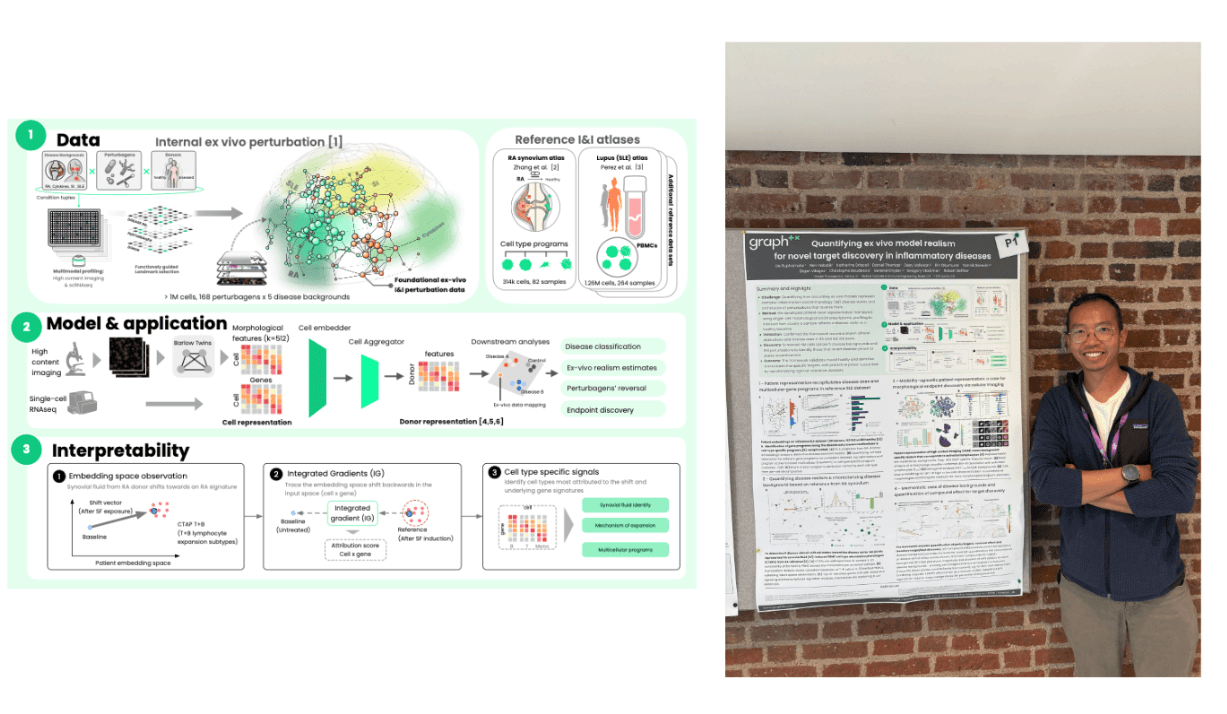
How close to a patient’s disease is a disease model in a dish? How much a compound that reverses a disease state in ex vivo donor cells tells us about patients depends on how closely that state resembles their disease. At Target Validation 2026 in Hinxton, we presented a patient-level representation in which we measure that resemblance and score compounds by whether they move treated donor profiles toward the control condition or further away.
Our patient-level representation framework embeds single cells from high-content imaging and single-cell RNA-seq into a donor-level representation for each condition tuple of donor, disease background and perturbagen, and maps more than 1M cells from our ex vivo perturbation data, across 168 perturbagens and 5 disease backgrounds, into the same space as published single-cell atlases from patients. On a published SLE dataset of 261 donors, we find a distinct disease axis from healthy in the donor embeddings, and recover known multi-cellular programs: interferon signaling, expressed across several cell types, and a cytotoxic program of NK and CD8 T cells. Represented jointly with the cell type abundance phenotypes of a published RA synovium atlas, healthy PBMCs exposed to RA synovial fluid consistently shift toward its T+B lymphocyte-enriched subtype. We confirm the T and B cell expansion by composition analysis and, using integrated gradients, trace the shift back to BCR signaling and transcriptional regulation modules in B cells. Compound effects are read in the same space: in each background, a compound’s shift is decomposed into its direction relative to the disease axis and its magnitude, and tested against an empirical null. Compounds whose profiles stay near the disease background count as inert.
For example, in the Apo-SAA background, our model of systemic inflammation, belnacasan scores as a reverser: it blocks caspase-1, the enzyme through which the NLRP3 inflammasome, an inflammation sensor in immune cells, acts, and it moves donor profiles back toward control. BMS-986299, which switches that sensor on, scores as an inducer and moves them further away.